Technology
The Gold Standard in Sonic Drilling Rigs
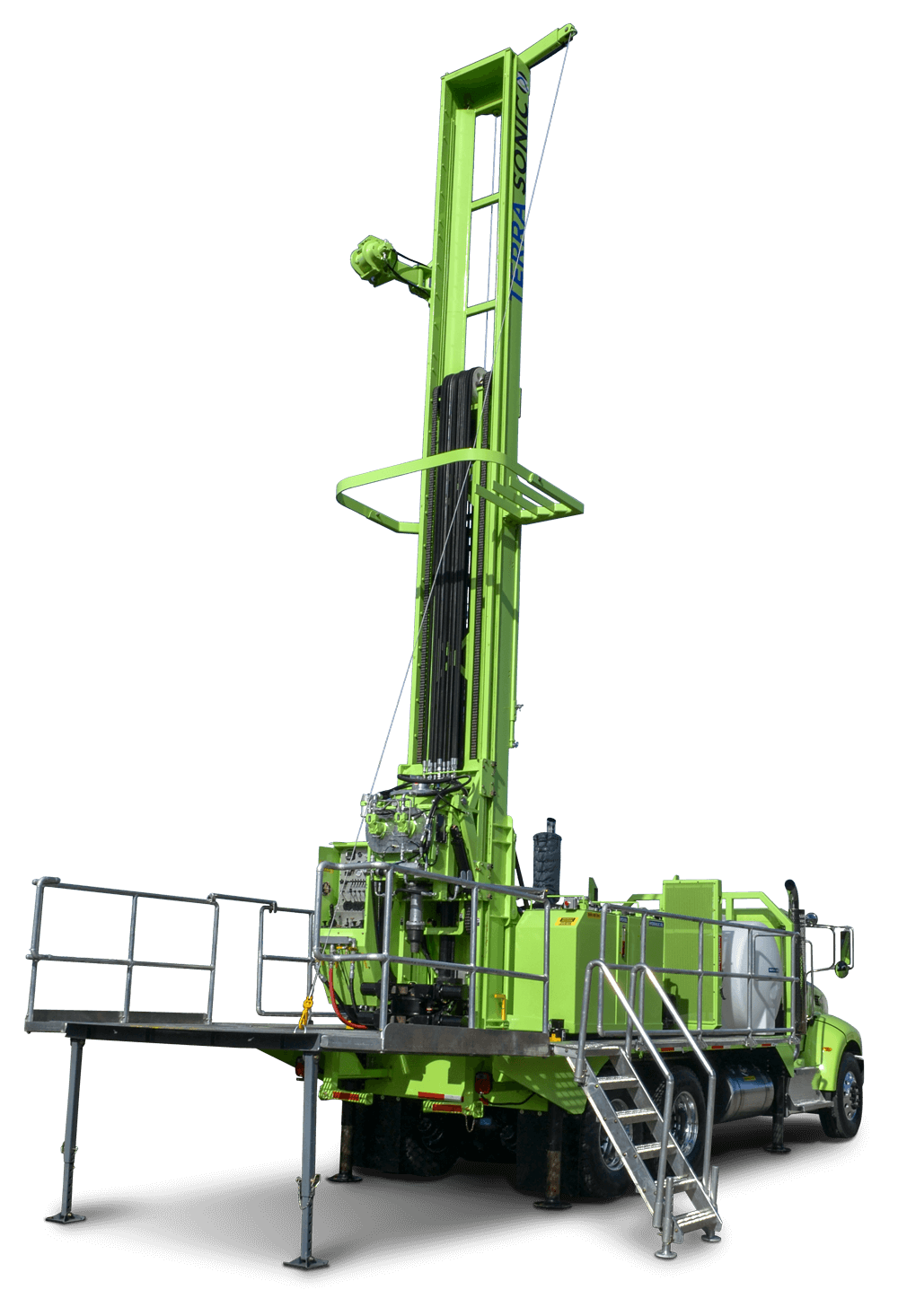
Terra Sonic International designs and manufactures the world's most advanced sonic drilling rigs — high-frequency, high-power equipment built for environmental, geotechnical, water well, and mining applications. With over 400 combined years of sonic drilling experience, we are the industry's most trusted name in sonic drill technology.
Technology
What Is Sonic Drilling?
Sonic drilling is a high-frequency rotary drilling method that uses resonant vibrational energy to advance a drill string through virtually any subsurface formation. The TSi sonic head oscillates at frequencies between 50 and 200 Hz, transmitting powerful resonant energy directly through the drill string to the bit face — fluidizing soil particles around the drill column and dramatically reducing friction and heat.
The result is dramatically faster penetration rates, continuous undisturbed core samples, and minimal waste generation — all with a smaller site footprint than conventional rotary or air-rotary methods. Sonic drilling can advance through cobbles, boulders, hardpan, clay, sand, gravel, and rock formations that routinely defeat conventional methods.
Terra Sonic's proprietary Trusonic Drilling Technology delivers the highest-force, highest-frequency output in the industry, maximizing penetration performance across the full range of subsurface conditions your projects demand.
Learn How Sonic Drilling WorksFaster Penetration
2–5x faster than conventional rotary drilling across most formation types
Continuous Core Samples
Undisturbed samples through every formation for accurate subsurface analysis
Minimal Site Impact
Significantly less waste cuttings and fluids — ideal for sensitive environmental sites
Drills Any Formation
Through cobbles, boulders, clay, rock — formations conventional methods cannot penetrate
The Case for Sonic
Why Conventional Drilling Rigs Can't Keep Up
Traditional rotary, air rotary, and hollow-stem auger rigs were engineered decades ago for a world that accepted slow penetration, poor sample quality, and high waste volumes. Sonic drilling makes each of those limitations obsolete.
The Old Way
Rotary, air rotary, hollow-stem auger, and cable tool rigs
-
Defeated by Difficult Formations
Cobbles, boulders, hardpan, and mixed overburden routinely stop conventional rigs cold — requiring casing, grouting, or abandonment of the borehole entirely.
-
Slow Penetration Rates
Conventional rotary drilling advances at a fraction of sonic speed — adding days or weeks to project timelines and dramatically increasing mobilization and labor costs.
-
Poor Sample Quality
Auger and rotary methods disturb, mix, and contaminate formation samples — undermining the accuracy of subsurface analysis and forcing costly re-drilling.
-
Massive Waste Generation
Conventional drilling produces large volumes of cuttings, drilling fluids, and contaminated waste that must be managed, transported, and disposed of — adding significant project cost and environmental liability.
-
High Water Consumption
Rotary methods depend on high water volumes for bit cooling and cuttings removal — creating logistical challenges on remote sites and adding to wastewater disposal costs.
-
Large Site Footprint
Conventional rigs require significant staging area, mud pits, and support equipment — making them impractical for urban, environmentally sensitive, and access-restricted sites.
-
Frequent Refusal & Downtime
Formation refusal, rod breakage, and bit wear are routine events with conventional drilling — generating costly downtime, equipment mobilization, and schedule overruns.
The Sonic Advantage
High-frequency resonant drilling by Terra Sonic International
-
Drills Through Anything
Sonic resonant energy fluidizes particles at the drill face — advancing through cobbles, boulders, mixed overburden, clay, sand, gravel, and bedrock without refusal.
-
2–5× Faster Penetration
TSi sonic rigs complete boreholes in a fraction of the time — compressing project timelines, reducing mobilization costs, and getting your crews to the next site faster.
-
Continuous Undisturbed Core
Sonic drilling delivers uninterrupted, undisturbed core samples through every formation change — giving geologists and engineers the accurate subsurface data they need the first time.
-
Minimal Waste & Cuttings
Sonic drilling generates a fraction of the waste cuttings and fluids compared to conventional methods — reducing environmental liability, disposal cost, and regulatory scrutiny on sensitive sites.
-
Low Water Requirements
Sonic drilling requires minimal water for operation — enabling access to remote, arid, and water-restricted sites where conventional rotary methods are logistically impractical.
-
Compact, Low-Impact Footprint
TSi rigs mobilize to urban, environmentally sensitive, and access-restricted sites that conventional equipment cannot reach — no mud pits, minimal surface disturbance.
-
Consistent Performance, Less Downtime
Sonic resonance adapts dynamically to formation changes — dramatically reducing formation refusal, equipment wear, and unexpected downtime that derail conventional drilling schedules.
Common Questions
Sonic Drilling — Frequently Asked Questions
Everything you need to know about sonic drilling technology and choosing the right sonic rig for your application.
What is sonic drilling and how does it work?
Sonic drilling uses high-frequency resonant energy — typically 50 to 200 Hz — transmitted through a drill string to advance a bit through soil and rock. The vibrational energy fluidizes particles at the drill face, dramatically reducing friction and enabling continuous undisturbed core recovery with minimal waste and a smaller site footprint than conventional methods.
What are the main advantages of sonic drilling over rotary drilling?
Sonic drilling is typically 2–5x faster than conventional rotary drilling, produces continuous undisturbed core samples, generates significantly less waste cuttings and fluids, and can penetrate formations — cobbles, boulders, mixed overburden — that defeat rotary methods. It also requires less water use and has a smaller environmental footprint on sensitive sites.
What industries and applications use sonic drill rigs?
Sonic drilling rigs are used in environmental site assessment and remediation, geotechnical investigation, water well installation, mineral and resource exploration, infrastructure projects (bridges, highways, dams), and offshore/nearshore applications. Any project requiring accurate subsurface sampling or access through challenging mixed formations benefits from sonic technology.
How do I choose the right TSi sonic rig for my project?
The right rig depends on site access, required depth, formation conditions, and production requirements. TSi offers compact crawlers (150CC) for tight-access sites, standard crawlers (150C) for general mobility, truck-mounted rigs (150T) for road-accessible projects, and the articulating crawler (150AC-8) for challenging terrain. Our application specialists provide free consultations to match you with the right rig.
Ready to See Sonic In Action?
Talk to a TSi application specialist about your project. We'll help you choose the right rig, walk you through our field demo program, and put together a quote tailored to your needs.
Call us directly: 866.365.3483 (USA) | sales@terrasonicinternational.com